
20261015 | 특새묵상 | 오벧에돔의 가문처럼… Like the Household of Obed-Edom | 대상/1Chron 26:1~19
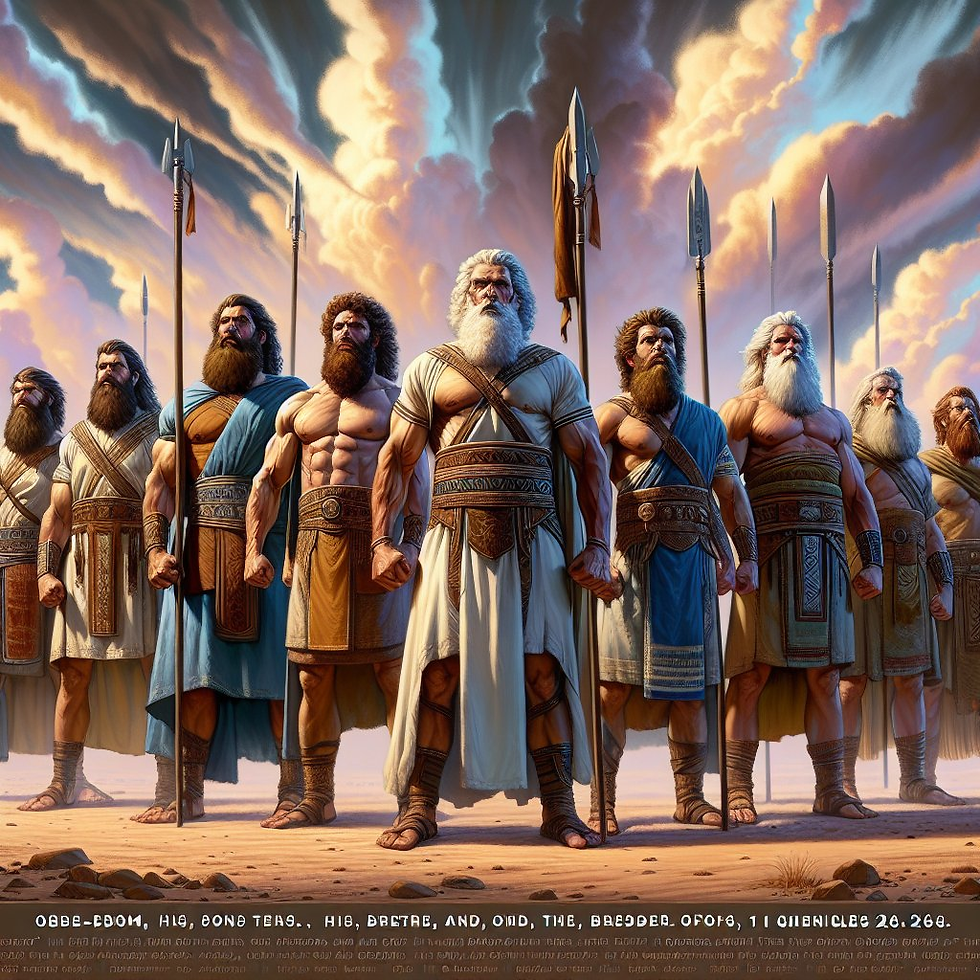
26:1 고라 사람들의 문지기 반들은 이러하니라 아삽의 가문 중 고레의 아들 므셀레먀라
26:2 므셀레먀의 아들들인 맏아들 스가랴와 둘째 여디야엘과 셋째 스바댜와 넷째 야드니엘과
26:3 다섯째 엘람과 여섯째 여호하난과 일곱째 엘여호에내이며
26:4 오벧에돔의 아들들은 맏아들 스마야와 둘째 여호사밧과 셋째 요아와 넷째 사갈과 다섯째 느다넬과
26:5 여섯째 암미엘과 일곱째 잇사갈과 여덟째 브울래대이니 이는 하나님이 오벧에돔에게 복을 주셨음이라
The Gatekeepers
1 The divisions of the gatekeepers:
From the Korahites: Meshelemiah son of Kore, one of the sons of Asaph.
2 Meshelemiah had sons:
Zechariah the firstborn,
Jediael the second,
Zebadiah the third,
Jathniel the fourth,
3 Elam the fifth,
Jehohanan the sixth
and Eliehoenai the seventh.
4 Obed-Edom also had sons:
Shemaiah the firstborn,
Jehozabad the second,
Joah the third,
Sakar the fourth,
Nethanel the fifth,
5 Ammiel the sixth,
Issachar the seventh
and Peullethai the eighth.
(For God had blessed Obed-Edom.)
26:6 그의 아들 스마야도 두어 아들을 낳았으니 그들의 조상의 가문을 다스리는 자요 큰 용사라
26:7 스마야의 아들들은 오드니와 르바엘과 오벳과 엘사밧이며 엘사밧의 형제 엘리후와 스마갸는 능력이 있는 자이니
26:8 이는 다 오벧에돔의 자손이라 그들과 그의 아들들과 그의 형제들은 다 능력이 있어 그 직무를 잘 하는 자이니 오벧에돔에게서 난자가 육십이 명이며
6 Obed-Edom’s son Shemaiah also had sons, who were leaders in their father’s family because they were very capable men. 7 The sons of Shemaiah: Othni, Rephael, Obed and Elzabad; his relatives Elihu and Semakiah were also able men. 8 All these were descendants of Obed-Edom; they and their sons and their relatives were capable men with the strength to do the work—descendants of Obed-Edom, 62 in all.
26:9 또 므셀레먀의 아들과 형제 열여덟 명은 능력이 있는 자라
9 Meshelemiah had sons and relatives, who were able men—18 in all.
26:10 므라리 자손 중 호사에게도 아들들이 있으니 그의 장자는 시므리라 시므리는 본래 맏아들이 아니나 그의 아버지가 장자로 삼았고
26:11 둘째는 힐기야요 셋째는 드발리야요 넷째는 스가랴이니 호사의 아들들과 형제들이 열세 명이더라
10 Hosah the Merarite had sons: Shimri the first (although he was not the firstborn, his father had appointed him the first), 11 Hilkiah the second, Tabaliah the third and Zechariah the fourth. The sons and relatives of Hosah were 13 in all.
26:12 이상은 다 문지기의 반장으로서 그 형제처럼 직임을 얻어 여호와의 성전에서 섬기는 자들이라
26:13 각 문을 지키기 위하여 그의 조상의 가문을 따라 대소를 막론하고 다 제비 뽑혔으니
12 These divisions of the gatekeepers, through their leaders, had duties for ministering in the temple of the Lord, just as their relatives had. 13 Lots were cast for each gate, according to their families, young and old alike.
26:14 셀레먀는 동쪽을 뽑았고 그의 아들 스가랴는 명철한 모사라 모사를 위하여 제비 뽑으니 북쪽을 뽑았고
26:15 오벧에돔은 남쪽을 뽑았고 그의 아들들은 곳간에 뽑혔으며
26:16 숩빔과 호사는 서방을 뽑아 큰길로 통한 살래겟 문 곁에 있어 서로 대하여 파수하였으니
26:17 동쪽 문에 레위 사람이 여섯이요 북쪽 문에 매일 네 사람이요 남쪽 문에 매일 네 사람이요 곳간에는 둘씩이며
26:18 서쪽 뜰에 있는 큰 길에 네 사람 그리고 뜰에 두 사람이라
26:19 고라와 므라리 자손의 문지기의 직책은 이러하였더라
14 The lot for the East Gate fell to Shelemiah. Then lots were cast for his son Zechariah, a wise counselor, and the lot for the North Gate fell to him. 15 The lot for the South Gate fell to Obed-Edom, and the lot for the storehouse fell to his sons. 16 The lots for the West Gate and the Shalleketh Gate on the upper road fell to Shuppim and Hosah.
Guard was alongside of guard: 17 There were six Levites a day on the east, four a day on the north, four a day on the south and two at a time at the storehouse. 18 As for the court to the west, there were four at the road and two at the court itself.
19 These were the divisions of the gatekeepers who were descendants of Korah and Merari.
에스겔 선지서를 보면 다음과 같은 말씀이 기록되어 있습니다.
너희가 이스라엘 땅에 관한 속담에 이르기를 아버지가 신 포도를 먹었으므로 그의 아들의 이가 시다고 함은 어찌 됨이냐 주 여호와의 말씀이니라 내가 나의 삶을 두고 맹세하노니 너희가 이스라엘 가운데에서 다시는 이 속담을 쓰지 못하게 되리라 모든 영혼이 다 내게 속한지라 아버지의 영혼이 내게 속함 같이 그의 아들의 영혼도 내게 속하였나니 범죄하는 그 영혼은 죽으리라… 아들은 아버지의 죄악을 담당하지 아니할 것이요 아버지는 아들의 죄악을 담당하지 아니하리니 의인의 공의도 자기에게로 돌아가고 악인의 악도 자기에게로 돌아가리라 (겔 18:2~4, 20)
성경은 범죄한 자와 관계가 있다는 이유만으로 함께 처벌을 하는 연좌제를 근본적으로 인정하지 않습니다. 모든 사람은 각자의 잘못과 죄악으로 인해 심판을 받는 것입니다. 또한 잘한 것도 그 잘한 사람이 칭찬을 받는 것입니다. 다만 죄악이나 선은 그 영향력이 있어서, 그 후손이나 관계있는 주변 사람들이 그 선한 영향력이든 악한 영향력이든 그 영향력을 받게 되는 것은 부인할 수 없습니다.
In the Book of the Prophet Ezekiel, the following word is recorded:
"What do you people mean by quoting this proverb about the land of Israel: 'The parents eat sour grapes, and the children’s teeth are set on edge'? As surely as I live, declares the Sovereign Lord, you will no longer quote this proverb in Israel. For every living soul belongs to me, the father as well as the son—both alike belong to me. The one who sins is the one who will die. … The child will not share the guilt of the parent, nor will the parent share the guilt of the child. The righteousness of the righteous will be credited to them, and the wickedness of the wicked will be charged against them." (Ezekiel 18:2–4, 20)
The Bible fundamentally does not recognize guilt by association (joint responsibility/guilt through relation), where someone is punished merely because of their connection to a transgressor. Every individual is judged according to their own faults and sins. Likewise, good deeds are commended to the specific individual who performed them. However, because righteousness and sin carry inherent influence, it cannot be denied that descendants or nearby related people are inevitably affected by that influence—whether for good or for bad.

고라의 후손들
레위는 게르손, 고핫(그핫), 므라리 세 명의 아들이 있었습니다. 모세와 아론은 고핫의 후손입니다. 그런데 민수기 16장을 보면, 고라와 다단과 온이 함께 당을 지어 모세와 아론을 대적합니다. 고라는 모세의 사촌으로 자신 역시 레위지파로서 제사장직을 감당할 수 있다고 주장한 것입니다.
그 결과는 너무도 참혹했습니다. 그들은 가족들과 함께 땅이 갈라져 생매장 당하는 최후를 맞이합니다. 또한 아론을 대항하여 다른 향로를 가지고 분향하던 250명도 죽었습니다. 그런데 놀랍게도 고라의 후손들이 남아 있었습니다. 바로 오늘 본문에 등장하는 아삽(본래 이름은 에비아삽으로 게르손의 후손인 찬양대장 아삽과는 다른사람)의 가문 중 고레의 아들 므셀레먀나, 오벧에돔이 바로 고라의 후손입니다.
어떻게 된 일일까요? 아마도 이미 출가하여 아버지 고라의 반역에 가담하지 않았던 자손들이 있었던 것으로 보입니다. 하나님은 아버지의 죄를 아들에게 묻지 않는다는 원칙대로 비록 반역한 고라는 심판을 하더라도, 그의 가문에서 하나님을 성실하게 사랑하는 자들에게는 여전히 동일하게 하나님을 섬길 수 있는 기회를 주신 것입니다. 그 역할이 성전의 문지기였습니다.
성전 문지기는 시설을 관리하고, 보안과 성전의 안전을 담당하는 역할이었습니다. 오늘날로 치자면 경호실이나 보안 담당과 같은 매우 중요한 역할입니다. 그래서 실제로 그들은 큰 용사로 전투에 능한 자들이었습니다.
첫번째 가문은 므셀레먀 집안입니다.
그는 일곱명의 아들과 형제를 합쳐 총 18명이 하나님의 성전 문지기 역할을 담당했습니다. 그리고 그들은 모두 능력이 있는 자라고 설명합니다(9).
두번째 가문은 오벧에돔의 집안입니다.
그의 집안은 총 62명이었고, 모두 다 능력이 있어 직무를 잘하는 자들이었다고 소개합니다(8).
마지막으로 호사 집안입니다.
호사는 레위의 세째 아들인 므라리의 후손입니다. 그 역시 네 명의 아들과 형제를 합쳐 총 13명이 성전 문지기 역할을 담당했습니다.
Here is the translation of the text into English:
Descendants of Korah
Levi had three sons: Gershon, Kohath, and Merari. Moses and Aaron are descendants of Kohath. However, in Numbers 16, Korah, Dathan, and Abiram form a faction and oppose Moses and Aaron. Korah, who was Moses' cousin, argued that as a Levite himself, he too was capable of serving in the priesthood.
The result was truly catastrophic. They met their end by being buried alive as the earth opened up beneath them along with their families. Furthermore, 250 men who offered incense with unauthorized censers in opposition to Aaron also perished. Yet surprisingly, descendants of Korah survived. Indeed, in today's text, Meshelemiah (son of Kore) and Obed-Edom—from the family of Asaph (whose original name was Ebiasaph, a different person from Asaph the chief musician who was a descendant of Gershon)—were descendants of Korah.
How did this happen? It appears there were descendants who had already moved out and did not participate in the rebellion of their father, Korah. In accordance with the principle that God does not hold children accountable for the sins of their fathers, even though He judged the rebellious Korah, He granted those in his family who faithfully loved God the same opportunity to serve Him. That role was serving as temple gatekeepers.
Temple gatekeepers were responsible for maintaining the facilities, ensuring security, and safeguarding the temple. In modern terms, this was a crucial role akin to a security detail or protective service. Because of this, they were actually mighty men of valor who were skilled in battle.
The first family is the household of Meshelemiah.
Together with his seven sons and brothers, a total of 18 members carried out the duty of temple gatekeepers. The text describes all of them as capable men (v. 9).
The second family is the household of Obed-Edom.
His household numbered 62 in total, and they are introduced as capable men well-qualified for their service (v. 8).
Lastly, there is the household of Hosah.
Hosah was a descendant of Merari, Levi’s third son. Together with his four sons and brothers, a total of 13 members served as temple gatekeepers.

오벧에돔의 가문처럼…
여기서 주목하고 싶은 가문은 오벧에돔의 집안입니다. 아시다시피 오벧에돔은 다윗 왕이 법궤를 운반하다가 웃사가 사망하는 사건이 일어나자, 석달동안 법궤를 맡겼던 집안입니다. 사무엘서 저자는 다음과 같이 기록합니다.
여호와의 궤가 가드 사람 오벧에돔의 집에 석 달을 있었는데
여호와께서 오벧에돔과 그의 온 집에 복을 주시니라 (사무엘하 6:11)
본래 오벧에돔은 레위인으로 국경지역인 가드 지역에 있어서 가드 사람이라고 불린 것입니다. 그래서 일시적으로 법궤를 맡는 것이 문제 없었던 것입니다. 그는 본래 문지기이지만 다윗이 다시 법궤를 운반할 때 악사의 역할을 감당합니다(대상 15:18). 그리고 그후에는 기브온 산당의 회막 문지기를 담당합니다(대상 16:38). 이러한 오벧에돔의 가문은 매우 본받고 싶은 가문이 됩니다.
먼저는 하나님은 오벧에돔의 집안에 복을 주셨습니다(5).
아마도 웃사의 사건 이후 더욱 두려운 존재가 된 여호와의 법궤를 성심성의껏 섬겼던 것으로 보입니다. 그 결과 하나님은 그의 집안에 복을 주셨습니다. 자녀가 많은 것이 하나님이 주신 복의 상징이었습니다.
다음으로 그의 후손들은 큰 용사였습니다(6).
큰 용사에 해당하는 히브리어는 깁보르 하일로 능력있는 사람, 지도자라는 의미입니다.
마지막으로 그의 후손들은 직무를 잘하는 사람이었습니다(8).
그들은 하나님이 맡기신 직무를 그대로 잘 수행하는 사람들이었습니다. 특출한 능력도 필요하지만, 그보다 더 중요한 것은 맡겨진 일을 성실하게 수행하는 꾸준함입니다. 그것이야말로 진정한 능력입니다.
Here is the translation of the text into English:
Like the Household of Obed-Edom…
The family I would like to focus on here is the household of Obed-Edom. As you know, Obed-Edom was the one whose home hosted the Ark of the Covenant for three months when King David was transporting it and the incident of Uzzah’s death occurred. The author of Samuel records it as follows:
"The ark of the Lord remained in the house of Obed-Edom the Gittite for three months, and the Lord blessed him and his entire household." (2 Samuel 6:11)
Originally a Levite, Obed-Edom was called a "Gittite" because he resided in the border region of Gath. Thus, taking temporary custody of the Ark was not a problem. Although he was primarily a gatekeeper, he played the role of a musician when David transported the Ark once again (1 Chron. 15:18). Afterward, he served as a gatekeeper for the Tabernacle at the high place in Gibeon (1 Chron. 16:38). Such a legacy makes the household of Obed-Edom a family truly worthy of emulation.
First, God blessed the household of Obed-Edom (v. 5).
He appears to have served the Ark of the Lord with utmost devotion, even though it had become an object of great dread following the Uzzah incident. As a result, God poured out blessings upon his household. Having many children was a symbol of God's blessing.
Second, his descendants were mighty men of valor (v. 6).
The Hebrew word corresponding to "mighty men of valor" is gibbor chayil, which means a person of ability, strength, or a leader.
Lastly, his descendants were highly capable in their duties (v. 8).
They were people who faithfully executed the work assigned to them by God. While exceptional ability is important, even more crucial is the consistency to carry out one's entrusted duties with integrity. That is true capability.

오벧에돔의 집안은 어찌보면 반역자의 후손으로 그저 역사의 뒤 편으로 조용히 사라질 수 있는 불리한 조건을 가진 집안이었습니다. 하지만 오벧에돔의 집안은 자신들에게 주어진 직무를 최선을 다해 성실하게 감당함으로 하나님의 축복을 받았습니다. 더 나아가 하나님 성전의 문지기를 감당하게 됩니다.
시편 84편은 고라자손의 시편입니다. 어쩌면 오벧에돔의 집안의 후손 중에 누군가가 부른 노래는 아닐까요?
그들은 다음과 같이 노래했습니다.
주의 궁정에서의 한 날이 다른 곳에서의 천 날보다 나은즉 악인의 장막에 사는 것보다
내 하나님의 성전 문지기로 있는 것이 좋사오니 (시 84:10)
그들이 자신들에게 주어진 임무를 얼마나 자랑스럽게 생각했는지, 그보다 얼마나 그 일을 사랑했는지 알 수 있습니다. 그리고 그 일을 사랑하는 마음은 바로 그 성전에 계신 하나님을 사랑하는 마음에서 출발하는 것입니다. 그들이 복을 받은 이유도 아마 이것 때문일 것입니다. 하나님을 사랑하는 그 마음…
In a sense, the household of Obed-Edom faced unfavorable conditions as the descendants of a rebel, a lineage that could have quietly faded into the background of history. However, by faithfully fulfilling the duties entrusted to them with all their heart, the household of Obed-Edom received God’s blessing. Furthermore, they came to serve as gatekeepers of God’s temple.
Psalm 84 is a psalm of the sons of Korah. Could it perhaps be a song sung by one of the descendants of Obed-Edom's household?
They sang as follows:
"Better is one day in your courts than a thousand elsewhere; I would rather be a doorkeeper in the house of my God than dwell in the tents of the wicked." (Psalm 84:10)
We can see how proud they were of the responsibility given to them, and even more so, how much they loved that work. And that heart of love for their duty stemmed directly from their love for God, who dwelt in that temple. This heart of love for God is likely the very reason they were blessed...


댓글