
20261014 | 특새묵상 | 신령한 노래로 예배하라 Worship in Spiritual Song | 대상/1Chron 25:1~31

25:1 다윗이 군대 지휘관들과 더불어 아삽과 헤만과 여두둔의 자손 중에서 구별하여 섬기게 하되 수금과 비하와 제금을 잡아 신령한 노래를 하게 하였으니 그 직무대로 일하는 자의 수효는 이러하니라
The Musicians
1 David, together with the commanders of the army, set apart some of the sons of Asaph, Heman and Jeduthun for the ministry of prophesying, accompanied by harps, lyres and cymbals. Here is the list of the men who performed this service:
25:2 아삽의 아들들은 삭굴과 요셉과 느다냐와 아사렐라니 이 아삽의 아들들이 아삽의 지휘 아래 왕의 명령을 따라 신령한 노래를 하며
2 From the sons of Asaph:
Zakkur, Joseph, Nethaniah and Asarelah. The sons of Asaph were under the supervision of Asaph, who prophesied under the king’s supervision.
25:3 여두둔에게 이르러서는 그의 아들들 그달리야와 스리와 여사야와 시므이와 하사뱌와 맛디디야 여섯 사람이니 그의 아버지 여두둔의 지휘 아래 수금을 잡아 신령한 노래를 하며 여호와께 감사하며 찬양하며
3 As for Jeduthun, from his sons:
Gedaliah, Zeri, Jeshaiah, Shimei, Hashabiah and Mattithiah, six in all, under the supervision of their father Jeduthun, who prophesied, using the harp in thanking and praising the Lord.
25:4 헤만에게 이르러는 그의 아들들 북기야와 맛다냐와 웃시엘과 스브엘과 여리못과 하나냐와 하나니와 엘리아다와 깃달디와 로맘디에셀과 요스브가사와 말로디와 호딜과 마하시옷이라
25:5 이는 다 헤만의 아들들이니 나팔을 부는 자들이며 헤만은 하나님의 말씀을 가진 왕의 선견자라 하나님이 헤만에게 열네 아들과 세 딸을 주셨더라
4 As for Heman, from his sons:
Bukkiah, Mattaniah, Uzziel, Shubael and Jerimoth; Hananiah, Hanani, Eliathah, Giddalti and Romamti-Ezer; Joshbekashah, Mallothi, Hothir and Mahazioth. 5 (All these were sons of Heman the king’s seer. They were given him through the promises of God to exalt him. God gave Heman fourteen sons and three daughters.)
25:6 이들이 다 그들의 아버지의 지휘 아래 제금과 비파와 수금을 잡아 여호와의 전에서 노래하여 하나님의 전을 섬겼으며 아삽과 여두둔과 헤만은 왕의 지휘 아래 있었으니
25:7 그들과 모든 형제 곧 여호와 찬송하기를 배워 익숙한 자의 수효가 이백 팔십 팔 명이라
25:8 이 무리의 큰 자나 작은 자나 스승이나 제자를 막론하고 다같이 제비 뽑아 직임을 얻었으니
6 All these men were under the supervision of their father for the music of the temple of the Lord, with cymbals, lyres and harps, for the ministry at the house of God.
Asaph, Jeduthun and Heman were under the supervision of the king. 7 Along with their relatives—all of them trained and skilled in music for the Lord—they numbered 288. 8 Young and old alike, teacher as well as student, cast lots for their duties.
25:9 첫째로 제비 뽑힌 자는 아삽의 아들 중 요셉이요 둘째는 그달리야이니 그와 그의 형제들과 아들들 십이 명이요
25:10 셋째는 삭굴이니 그의 아들들과 형제들과 십이 명이요
25:11 넷째는 이스리이니 그의 아들들과 형제들과 십이 명이요
25:12 다섯째는 느다냐니 그의 아들들과 형제들과 십이 명이요
25:13 여섯째는 북기야니 그의 아들들과 형제들과 십이 명이요
25:14 일곱째는 여사렐라니 그의 아들들과 형제들과 십이 명이요
25:15 여덟째는 여사야니 그의 아들들과 형제들과 십이 명이요
25:16 아홉째는 맛다냐니 그의 아들들과 형제들과 십이 명이요
25:17 열째는 시므이니 그의 아들들과 형제들과 십이 명이요
25:18 열한째는 아사렐이니 그의 아들들과 십이 명이요
25:19 열두째는 하사뱌니 그의 아들들과 십이 명이요
25:20 열셋째는 수바엘이니 그의 아들들과 십이 명이요
25:21 열넷째는 맛디디야니 그의 아들들과 형제들과 십이 명이요
25:22 열다섯째는 여레못이니 그의 아들들과 형제들과 십이 명이요
25:23 열여섯째는 하나냐니 그의 아들들과 형제들과 십이 명이요
25:24 열일곱째는 요스브가사니 그의 아들들과 형제들과 십이 명이요
25:25 열여덟째는 하나니니 그의 아들들과 형제들과 십이 명이요
25:26 열아홉째는 말로디니 그의 아들들과 형제들과 십이 명이요
25:27 스무째는 엘리아다니 그의 아들들과 형제들과 십이 명이요
25:28 스물한째는 호딜이니 그의 아들들과 형제들과 십이 명이요
25:29 스물두째는 깃달디니 그의 아들들과 형제들과 십이 명이요
25:30 스물셋째는 마하시옷이니 그의 아들들과 형제들과 십이 명이요
25:31 스물넷째는 로맘디에셀이니 그의 아들들과 형제들과 십이 명이었더라
9 The first lot, which was for Asaph, fell to Joseph,
his sons and relatives 12
the second to Gedaliah,
him and his relatives and sons 12
10 the third to Zakkur,
his sons and relatives 12
11 the fourth to Izri,
his sons and relatives 12
12 the fifth to Nethaniah,
his sons and relatives 12
13 the sixth to Bukkiah,
his sons and relatives 12
14 the seventh to Jesarelah,
his sons and relatives 12
15 the eighth to Jeshaiah,
his sons and relatives 12
16 the ninth to Mattaniah,
his sons and relatives 12
17 the tenth to Shimei,
his sons and relatives 12
18 the eleventh to Azarel,
his sons and relatives 12
19 the twelfth to Hashabiah,
his sons and relatives 12
20 the thirteenth to Shubael,
his sons and relatives 12
21 the fourteenth to Mattithiah,
his sons and relatives 12
22 the fifteenth to Jerimoth,
his sons and relatives 12
23 the sixteenth to Hananiah,
his sons and relatives 12
24 the seventeenth to Joshbekashah,
his sons and relatives 12
25 the eighteenth to Hanani,
his sons and relatives 12
26 the nineteenth to Mallothi,
his sons and relatives 12
27 the twentieth to Eliathah,
his sons and relatives 12
28 the twenty-first to Hothir,
his sons and relatives 12
29 the twenty-second to Giddalti,
his sons and relatives 12
30 the twenty-third to Mahazioth,
his sons and relatives 12
31 the twenty-fourth to Romamti-Ezer,
his sons and relatives 12
다윗은 믿음을 계승하기 위해서 솔로몬을 후계자로 지명합니다. 그리고 성전 건축을 위한 모든 준비를 마칩니다. 또한 성전에서 진행되는 예배를 위해서 제사장과 레위인들의 조직을 재정비합니다. 그리고 오늘 본문에서는 레위인들 중 또 다른 그룹인 찬양대에 관한 조직을 정비합니다. 다윗은 세 명의 찬양대 대장 아삽과 헤만과 여두둔을 세우는데, 이는 군대장관과 같은급 입니다. 그리고 이들은 신령한 노래와 현악기(수금, 비파), 타악기(제금), 관악기(나팔, 5절) 등을 이용하여 하나님께 신령한 노래를 부릅니다. 합창과 오케스트라로 함께 하나님을 찬양하는 것입니다.
이러한 조직적인 찬양대의 성경적인 근거는 무엇일까요? 역대하를 보면 다음과 같은 말씀이 나옵니다.
왕이 레위 사람들을 여호와의 전에 두어서 다윗과 왕의 선견자 갓과 선지자 나단이 명령한 대로
제금과 비파와 수금을 잡게 하니 이는 여호와께서 그의 선지자들로 이렇게 명령하셨음이라 (대하 29:25)
그러니까 조직적인 찬양대는 다윗이 그냥 음악을 좋아하고, 음악에 조예가 깊어서 시작한 것이 아니라, 선지자를 통하여 정확한 하나님의 지시하심을 받고 하나님을 예배하기 위해 조직된 것입니다.
David designated Solomon as his successor in order to pass down the faith. He also completed all the preparations for building the Temple and reorganized the structure of the priests and Levites for the worship services conducted in it. In today's passage, he organizes another group among the Levites: the choir. David appointed three choir leaders—Asaph, Heman, and Jeduthun—a rank equivalent to military commanders. Using spiritual songs as well as stringed instruments (harps and lyres), percussion (cymbals), and wind instruments (trumpets, v. 5), they sang spiritual songs to God. Together, as a choir and orchestra, they praised God.
What is the biblical basis for such an organized choir? In 2 Chronicles, we find the following verse:
"He stationed the Levites in the temple of the Lord with cymbals, harps, and lyres in the way prescribed by David and Gad the king’s seer and Nathan the prophet; for this was commanded by the Lord through his prophets." (2 Chronicles 29:25)
Therefore, an organized choir was not created simply because David loved music or was deeply skilled in it; rather, it was established to worship God according to the clear instructions received from Him through the prophets.

이스라엘의 찬송 중에 거하시는 하나님
다윗은 “이스라엘의 찬송 중에 거하시는 주여 주는 거룩하시니이다.”(시 22:3)라고 노래합니다. 그러니까 다윗에 의하면 찬송은 하나님이 거하시는 안방이라는 말입니다. 여기서 간단하게 찬양과 찬송에 대한 정의를 살펴보자면 다음과 같습니다.
찬양은 단순히 음악이나 멜로디에 맞춰 노래하는 행위를 넘어, 하나님의 위대하심, 거룩하심, 구원의 은혜, 그리고 그분의 성품과 행하신 모든 일에 대해 전적으로 인정하고 높여드리는 행위를 뜻합니다. 찬양은 인간에게 생명을 주신 목적이자 본분이며, 하나님과의 깊은 인격적 교제 속에서 그분께 영광과 존귀를 올려드리는 신앙의 최고 표현입니다.
반면에 찬송은 찬양에 곡조를 입힌 노래를 말합니다. 그러니까 찬양이 하나님을 높이는 행위에 대한 포괄적인 개념이라면, 찬송은 그중에서 음악이나 시를 가지고 하나님을 높이는 협의적인 개념입니다.
한편 구약 성경에는 찬양을 뜻하는 몇 가지 대표적인 히브리어 단어가 있으며, 각각 조금씩 다른 뉘앙스를 담고 있습니다.
가장 대표적인 단어는 할렐, 할랄Halal로, 그 의미는 자랑하다, 칭찬하다, 우러러보다, 환호하다 입니다. 이것은 하나님을 찬양하라는 의미의 할렐루야의 어근으로, 하나님의 위대하심 앞에 감탄하며 열정적으로 그분을 높이고 자랑하는 찬양을 뜻합니다.
다음은 야다Yadah로, 그 의미는 (손을) 높이 들다, 고백하다, 감사하다 라는 의미입니다.
두 손을 높이 들거나 뻗어 하나님께 항복하고, 감사하며, 그분의 주권을 인정하면서 드리는 찬양입니다.
세번째는 바라크Barak로 그 의미는 무릎을 꿇다, 송축하다, 축복하다 입니다.
창조주 하나님 앞에 겸손히 무릎을 꿇고 그분께 경배와 감사를 올리는 경건한 태도를 담고 있습니다.
마지막으로 테힐라Tehillah는 그 의미가 찬송, 찬양의 노래입니다.
할렐에서 유래한 명사형으로, 하나님을 향해 마음에서 우러나와 부르는 구체적인 찬양의 노래나 내용 자체를 의미합니다. 앞서 인용한 시편 22:3의 "이스라엘의 찬송 중에" 쓰인 단어가 바로 테힐라입니다.
God Who Dwells in the Praises of Israel
David sings, “Yet you are holy, enthroned on the praises of Israel” (Psalm 22:3). In other words, according to David, praise is the very inner room where God dwells. To briefly examine the definitions of praise (chanyang) and hymn/song of praise (chansong):
Praise (Chanyang) goes beyond the simple act of singing to music or melody. It refers to the act of fully acknowledging and exalting God’s greatness, holiness, saving grace, character, and all that He has done. Praise is the very purpose and duty for which human life was given, as well as the highest expression of faith—offering glory and honor to God within a deep, personal relationship with Him.
Hymn/Song of Praise (Chansong), on the other hand, refers to praise set to a tune. Thus, while praise is a comprehensive concept referring to the act of exalting God, chansong is a narrower concept specifically referring to exalting God through music or poetry.
Meanwhile, the Old Testament contains several representative Hebrew words for praise, each carrying slightly different nuances:
Halal / Hallel: Meaning to boast, praise, look up to, or acclaim. This is the root of Hallelujah ("praise God") and signifies passionate praise that exalts and boasts of God in awe of His greatness.
Yadah: Meaning to raise (hands) high, confess, or give thanks. It refers to praise offered by lifting or extending both hands high to surrender to God, give thanks, and acknowledge His sovereignty.
Barak: Meaning to kneel, bless, or adore. It reflects a reverent posture of humbly kneeling before God the Creator to offer worship and thanksgiving.
Tehillah: Meaning a song of praise, hymn. A noun derived from Halal, it refers to the specific song or content of praise arising from the heart toward God. The word used in Psalm 22:3—"in the praises of Israel"—is precisely Tehillah.
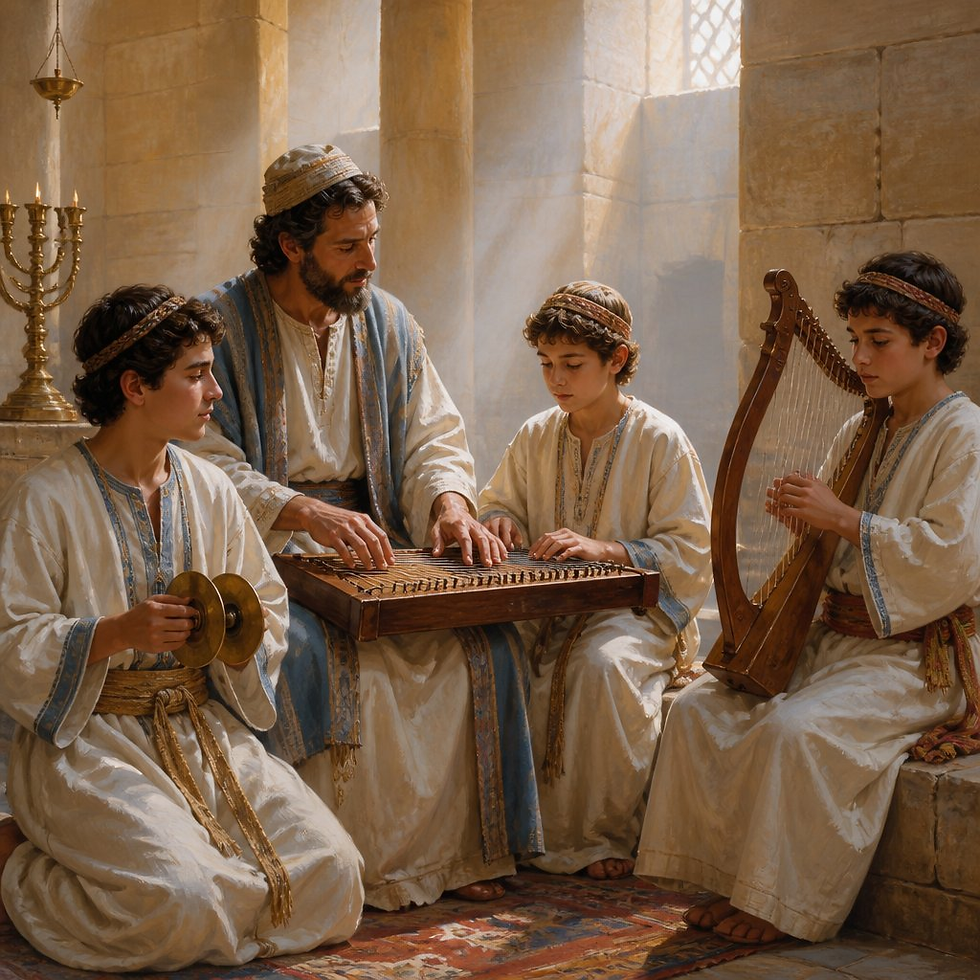
오늘날 예배 음악
다윗은 찬양대에 있어서도 아삽, 헤만, 여두둔의 세 팀을 24개조로 구성하여 하나님을 향한 신령한 노래를 부르게 합니다. 여기서 신령한 노래에 해당하는 히브리어 한닙바임은 예언한다 라는 의미입니다. 그래서 그들-헤만(5절), 아삽(대하 29:30), 여두둔(대하 35:15)-은 하나님의 말씀을 가진 선견자로 여겨졌습니다.
한편 이 찬양대는 분명한 규칙이 있었습니다.
첫번째는 정확한 질서체계 아래서 하나님을 찬양했다는 것입니다(6).
아삽의 지휘 아래(2), 여두둔의 지휘 아래(3), 아버지(헤만)의 지휘 아래(6)라는 표현이 반복적으로 등장합니다. 주로 세 명의 찬양대장의 자녀들이 아버지인 대장의 지휘 아래 세 개의 팀으로 나뉘어져 각자의 재능을 가지고 하나님을 찬양한 것입니다.
또한 아삽과 여두둔과 헤만은 왕의 지휘 아래 있었다(6b)고 기록합니다. 음악을 한다고 자기 마음대로 예술 혼을 펼치는 것이 아닙니다. 진정한 예술은 하나님을 찬양하는 것에 쓰임 받을 때 그 의미가 있는 것입니다. 그것도 하나님이 세우신 질서 아래서 말입니다.
두번째는 큰 자나 작은 자나 스승이나 제자를 막론하고 다같이 제비를 뽑아 직임을 얻었습니다(8).
차례나 위치, 순서에 특히나 민감한 것이 예술 세계인데, 다윗은 찬양대 역시 스승, 제자 가리지 않고 제비를 뽑아 하나님의 예배를 섬기도록 했습니다. 하나님을 찬양하는 일은 질서와 더불어 누구나 마음껏 하나님을 높일 수 있는 공정함도 있어야 합니다.
Worship Music Today
Regarding the choir, David organized the three teams of Asaph, Heman, and Jeduthun into 24 divisions to sing spiritual songs to God. Here, the Hebrew word for "spiritual songs," hanniBBa'im, means "to prophesy." Consequently, these leaders—Heman (v. 5), Asaph (2 Chron 29:30), and Jeduthun (2 Chron 35:15)—were considered seers who possessed the word of God.
Furthermore, this choir operated under clear and distinct principles:
They praised God under a clear system of order (v. 6). Phrases such as "under the direction of Asaph" (v. 2), "under the direction of Jeduthun" (v. 3), and "under the direction of their father [Heman]" (v. 6) appear repeatedly. Primarily, the children of these three choir leaders were divided into three teams under their fathers' leadership, using their respective talents to praise God.
Additionally, the text notes that Asaph, Jeduthun, and Heman were "under the king’s order" (v. 6b). Engaging in music does not mean expressing one's artistic spirit at will. True art finds its purpose when used to praise God—and done so under the order God has established.
They assigned duties by casting lots, without distinction between young or old, teacher or student (v. 8). The artistic world is often sensitive to status, position, and rank. Yet David ensured that for the choir as well, teachers and students alike cast lots to serve in worshiping God. Praising God requires not only order, but also fairness so that anyone may exalt Him freely.

이제 찬양대를 오늘날 예배에 적용해 볼 시간입니다. 찬양대에 대한 성경적인 근거는 구약의 성전제사, 특히 다윗의 예배 개혁 시기에서 찾아 볼 수 있었습니다. 하지만 신약성경에서는 그 유래를 찾을 수 없습니다. 그렇다면 우리는 이러한 구약 성경의 기록을 어떻게 오늘날 예배에 적용할 수 있을까요?
성전도 없어지고, 더불어 제사장, 레위인의 역할도 없어졌습니다. 신약시대, 성령시대, 곧 오늘날에는 제사장과 레위인이 누구라고 말씀 드렸습니까? 그렇습니다. 바로 우리들입니다. 찬양대도 마찬가지입니다. 찬양, 음악, 찬송은 특별한 소수 몇사람의 전유물이 아닙니다. 찬양은 모든 성도들이 마땅히 하나님께 드려야 할 최고의 것입니다.
마틴 루터가 당시 라틴어로만 되어 있던 성경을 일반인들의 언어(독어)로 번역하여 성도들이 말씀을 읽을 수 있게 되면서 예배와 종교의 개혁이 일어났습니다. 찬송도 마찬가지입니다. 마틴 루터는 많은 회중찬송을 작곡작사하여 성도들이 직접 하나님을 찬양하도록 도왔습니다. 왜냐하면 몇몇 노래 잘하는 멋진 사람들의 찬송을 듣는 것이 하나님이 원하시는 찬양이 아니기 때문입니다. 사실 성가대만큼 (자칫 잘못하면) 예배를 종교개혁 전으로 돌리는 제도도 없습니다. 그것은 마치 목사 대신 제사장이 예배를 섬기고, 성도들 대신 레위인들이 예배를 수종드는 것과 다르지 않습니다.
오늘날 예배에서 성가대는 모든 예배 봉사자들이 차고 넘칠 때, 정말 봉사하고 싶은데 봉사할 자리가 없을 때 마지막으로 만들어도 되는 조직입니다. 그것마저도 조심스럽습니다. 하나님을 찬양하는 찬송으로 자신의 오락이나, 취미 생활, 자기 만족을 삼는 것은 예배가 아니기 때문입니다. 진짜 찬양대가 누구입니까? 이 시대에 아삽과 헤만과 여두둔이 누구입니까? 바로 회중 성도들입니다. 우리가 찬양대인 것입니다.
Applying the Choir to Today's Worship
Now it is time to apply the principle of the choir to worship today. The biblical foundation for a choir can be found in Old Testament temple worship, especially during David’s era of worship reform. However, we do not find its origins in the New Testament. How, then, should we apply these Old Testament accounts to modern worship?
The Temple no longer exists, and with it, the roles of priests and Levites have passed away. Who are the priests and Levites in the New Testament era—the era of the Holy Spirit, which is today? That's right: it is us. The same applies to the choir. Praise, music, and hymns are not the exclusive privilege of a select few. Praise is the highest gift that all believers ought to offer to God.
When Martin Luther translated the Bible—which was only in Latin at the time—into the common language of the people (German), believers were able to read the Word, sparking the Reformation of worship and religion. The same was true for songs of praise. Luther composed and wrote lyrics for many congregational hymns to help believers praise God directly. This is because listening to the singing of a few talented, impressive individuals is not the kind of praise God desires. In fact, if we are not careful, few institutions can pull worship back to its pre-Reformation state as easily as a choir can. It would be no different from having a priest serve the worship service instead of a pastor, or Levites ministering on behalf of the congregation.
In today's worship, a church choir should be established only as a last resort—when all other ministry positions are overflowing and people who truly desire to serve have nowhere else to serve. Even then, it must be approached with caution. Using songs of praise to God as a form of personal entertainment, a hobby, or self-satisfaction is not true worship. Who is the real choir? Who are the Asaphs, Hemans, and Jeduthuns of this age? It is the congregation. We are the choir.


댓글