
20260916 [새벽묵상] 패가망신 敗家亡身 Ruining Your Family and Destroying Yourself (대상/1Chron 9:35~10:14)

9:35 기브온의 조상 여이엘은 기브온에 거주하였으니 그의 아내의 이름은 마아가라
9:36 그의 맏아들은 압돈이요 다음은 술과 기스와 바알과 넬과 나답과
9:37 그돌과 아히오와 스가랴와 미글롯이며
9:38 미글롯은 시므암을 낳았으니 그들은 그들의 친족들과 더불어 마주하고 예루살렘에 거주하였더라
9:39 넬은 기스를 낳고 기스는 사울을 낳고 사울은 요나단과 말기수아와 아비나답과 에스바알을 낳았으며
9:40 요나단의 아들은 므립바알이라 므립바알은 미가를 낳았고
9:41 미가의 아들들은 비돈과 멜렉과 다레아와 아하스이며
9:42 아하스는 야라를 낳고 야라는 알레멧과 아스마웻과 시므리를 낳고 시므리는 모사를 낳고
9:43 모사는 비느아를 낳았으며 비느아의 아들은 르바야요 그의 아들은 엘르아사요 그의 아들은 아셀이며
9:44 아셀이 여섯 아들이 있으니 그들의 이름은 아스리감과 보그루와 이스마엘과 스아랴와 오바댜와 하난이라 아셀의 아들들이 이러하였더라
The Genealogy of Saul
35 Jeiel the father of Gibeon lived in Gibeon.
His wife’s name was Maakah, 36 and his firstborn son was Abdon, followed by Zur, Kish, Baal, Ner, Nadab, 37 Gedor, Ahio, Zechariah and Mikloth. 38 Mikloth was the father of Shimeam. They too lived near their relatives in Jerusalem.
39 Ner was the father of Kish, Kish the father of Saul, and Saul the father of Jonathan, Malki-Shua, Abinadab and Esh-Baal.
40 The son of Jonathan:
Merib-Baal, who was the father of Micah.
41 The sons of Micah:
Pithon, Melek, Tahrea and Ahaz.
42 Ahaz was the father of Jadah, Jadah was the father of Alemeth, Azmaveth and Zimri, and Zimri was the father of Moza. 43 Moza was the father of Binea; Rephaiah was his son, Eleasah his son and Azel his son.
44 Azel had six sons, and these were their names:
Azrikam, Bokeru, Ishmael, Sheariah, Obadiah and Hanan. These were the sons of Azel.
10:1 블레셋 사람들과 이스라엘이 싸우더니 이스라엘 사람들이 블레셋 사람들 앞에서 도망하다가 길보아 산에서 죽임을 당하여 엎드러지니라
10:2 블레셋 사람들이 사울과 그 아들들을 추격하여 블레셋 사람들이 사울의 아들 요나단과 아비나답과 말기수아를 죽이고
10:3 사울을 맹렬히 치며 활 쏘는 자가 사울에게 따라 미치매 사울이 그 쏘는 자로 말미암아 심히 다급하여
10:4 사울이 자기의 무기를 가진 자에게 이르되 너는 칼을 빼어 그것으로 나를 찌르라 할례 받지 못한 자들이 와서 나를 욕되게 할까 두려워하노라 그러나 그의 무기를 가진 자가 심히 두려워하여 행하기를 원하지 아니하매 사울이 자기 칼을 뽑아서 그 위에 엎드러지니
10:5 무기 가진 자가 사울이 죽는 것을 보고 자기도 칼에 엎드러져 죽으니라
10:6 이와 같이 사울과 그의 세 아들과 그 온 집안이 함께 죽으니라
Saul Takes His Life
1 Now the Philistines fought against Israel; the Israelites fled before them, and many fell dead on Mount Gilboa. 2 The Philistines were in hot pursuit of Saul and his sons, and they killed his sons Jonathan, Abinadab and Malki-Shua. 3 The fighting grew fierce around Saul, and when the archers overtook him, they wounded him.
4 Saul said to his armor-bearer, “Draw your sword and run me through, or these uncircumcised fellows will come and abuse me.”
But his armor-bearer was terrified and would not do it; so Saul took his own sword and fell on it. 5 When the armor-bearer saw that Saul was dead, he too fell on his sword and died. 6 So Saul and his three sons died, and all his house died together.
10:7 골짜기에 있는 모든 이스라엘 사람이 그들의 도망한 것과 사울과 그의 아들들이 다 죽은 것을 보고 그 성읍들을 버리고 도망하매 블레셋 사람들이 와서 거기에 거주하니라
10:8 이튿날에 블레셋 사람들이 와서 죽임을 당한 자의 옷을 벗기다가 사울과 그의 아들들이 길보아 산에 엎드러졌음을 보고
10:9 곧 사울의 옷을 벗기고 그의 머리와 갑옷을 가져다가 사람을 블레셋 땅 사방에 보내 모든 이방 신전과 그 백성에게 소식을 전하고
10:10 사울의 갑옷을 그들의 신전에 두고 그의 머리를 다곤의 신전에 단지라
10:11 길르앗야베스 모든 사람이 블레셋 사람들이 사울에게 행한 모든 일을 듣고
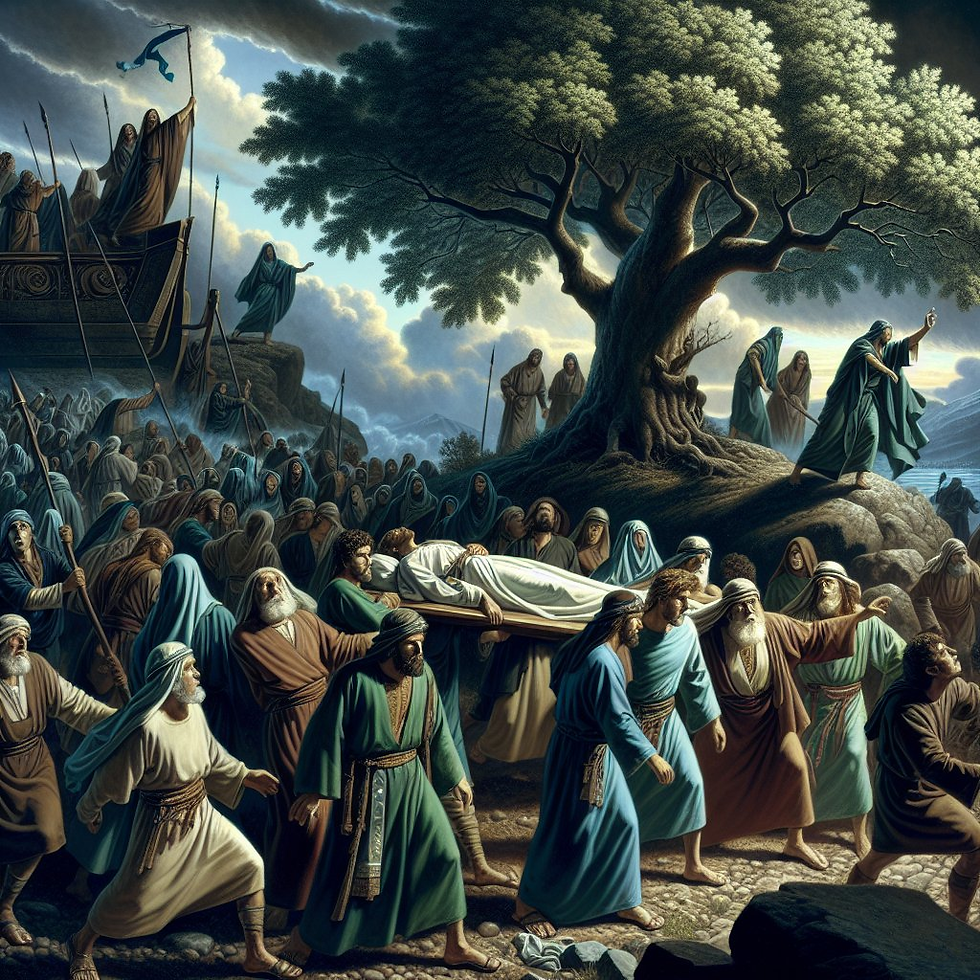
10:12 용사들이 다 일어나서 사울의 시체와 그의 아들들의 시체를 거두어 야베스로 가져다가 그 곳 상수리나무 아래에 그 해골을 장사하고 칠 일간 금식하였더라
7 When all the Israelites in the valley saw that the army had fled and that Saul and his sons had died, they abandoned their towns and fled. And the Philistines came and occupied them.
8 The next day, when the Philistines came to strip the dead, they found Saul and his sons fallen on Mount Gilboa. 9 They stripped him and took his head and his armor, and sent messengers throughout the land of the Philistines to proclaim the news among their idols and their people. 10 They put his armor in the temple of their gods and hung up his head in the temple of Dagon.
11 When all the inhabitants of Jabesh Gilead heard what the Philistines had done to Saul, 12 all their valiant men went and took the bodies of Saul and his sons and brought them to Jabesh. Then they buried their bones under the great tree in Jabesh, and they fasted seven days.
10:13 사울이 죽은 것은 여호와께 범죄하였기 때문이라 그가 여호와의 말씀을 지키지 아니하고 또 신접한 자에게 가르치기를 청하고
10:14 여호와께 묻지 아니하였으므로 여호와께서 그를 죽이시고 그 나라를 이새의 아들 다윗에게 넘겨주셨더라
13 Saul died because he was unfaithful to the Lord; he did not keep the word of the Lord and even consulted a medium for guidance, 14 and did not inquire of the Lord. So the Lord put him to death and turned the kingdom over to David son of Jesse.
패가망신 敗家亡身은 개인의 잘못으로 자신만 망가지는 것이 아니라, 온 집안이 망한다는 의미입니다. 오늘 본문의 사건이 정확하게 이 사자성어에 해당합니다. 아버지 사울 한 사람의 잘못으로 인하여, 사울 자신 뿐 아니라 세 명의 아들들과 신하들, 그리고 이스라엘 전체가 치욕스러운 패배를 맛보게 됩니다. 역대기 저자는 “이와 같이 사울과 그의 세 아들과 그 온 집안이 함께 죽으니라.”고 기록합니다(6).
The Korean saying (패가망신) implies that through an individual's wrongdoing, not only is that person ruined, but their entire family is brought to ruin. The event in today's passage corresponds exactly to this four-character idiom. Due to the fault of one father, Saul, not only Saul himself, but also his three sons, his officials, and all of Israel suffered a disgraceful defeat. The author of Chronicles records: "So Saul and his three sons died, and all his house died together." (v. 6)

사울의 족보 (9:35~44절)
이 부분은 사울의 족보로 8:29~38절을 그대로 중복합니다. 이 부분에서 다시 반복하는 이유는 10장에 사울의 마지막 이야기가 나오기 때문입니다. 하나님께서 직접 임명하신 왕은 베냐민 지파의 사울과 유다 지파의 다윗 밖에는 없습니다. 그래서 역대기 저자는 사울의 족보를 무게 있게 다루는 것입니다
사울의 아들들 이름이 나오는데 넷째 아들이 에스바알입니다(39). 그 의미는 바알의 사람, 주의 사람이라는 의미입니다. 본래 바알은 일반적으로 주인, 남편이라는 의미였습니다. 그런데 점점 바알 우상숭배가 만연하면서 우상의 이름으로 대명사가 되어버린 것입니다.
그래서 그의 이름을 이스보셋, 곧 수치의 사람, 부끄러운 자로 바뀐 것입니다. 아마도 바알이라는 이름이 더 이상 수치스러워서 사용할 수 없었기 때문일 것입니다. 그는 아버지 사울이 전사하자 이어서 북이스라엘의 왕이 되었습니다.
요나단의 아들 므비보셋도 마찬가지입니다(40). 그의 본래 이름은 므립바알입니다. 그 의미는 바알은 다투시는 분이다 또는 바알과 다투는 자라는 의미입니다. 하지만 삼촌인 이스보셋과 같은 이유로 그 이름을 므비보셋으로 개명한 것입니다.
Saul’s Genealogy (v. 35–44)
This section presents Saul’s genealogy, repeating 8:29–38 word-for-word. The reason it is repeated here is that Saul’s final narrative appears in chapter 10. The only kings directly appointed by God were Saul of the tribe of Benjamin and David of the tribe of Judah. For this reason, the author of Chronicles treats Saul’s genealogy with significant weight.
The names of Saul’s sons are mentioned, with his fourth son named Eshbaal (v. 39). It means "man of Baal" or "man of the Lord." Originally, Baal generally meant "master" or "husband." However, as Baal worship gradually spread, it became synonymous with the idol itself.
Consequently, his name was changed to Ish-bosheth, meaning "man of shame" or "shameful one." This was likely because the name Baal had become too disgraceful to use. Following the death of his father Saul in battle, he succeeded him as king of northern Israel.
The same applies to Jonathan’s son, Mephibosheth (v. 40). His original name was Merib-baal, which means "Baal contends" or "one who strives with Baal." However, for the same reason as his uncle Ish-bosheth, his name was changed to Mephibosheth.

패가망신 (10:1~14절)
역대기 10장은 사무엘상 31:1~13절의 내용과 몇 단어만 빼고 거의 동일합니다.
이스라엘은 블레셋에게 패하여 도망하다가 길보아 산에서 죽임을 당합니다. 여기서 죽임을 당한다에 해당하는 단어의 본래 의미는 구멍을 뚫다, 상처를 입다 로, 치명적인 상처를 입고 살해된 지저분한 모습을 의미합니다. 이스라엘의 패배가 매우 심각했음을 상징적으로 나타내는 단어입니다(1).
역대기 저자는 사울이 불레셋의 활 쏘는 자에게 쫓기어 심히 다급했다고 기록합니다(3). 하지만 사무엘서 저자는 사울이 패전하매 활 쏘는 자가 따라잡으니 사울이 그 활 쏘는 자에게 중상을 입은지라(삼상 31:3) 라고 정확하게 기록합니다.
심각한 부상을 입은 사울은 자신이 할례 받지 않은 블레셋 사람들에게 죽는 것이 싫어서 자신의 부하에게 자기를 죽이라고 명령합니다. 하지만 그의 무기 든 자는기름 부음 받은 왕을 죽이는 것을 혐오합니다. 이에 사울은 스스로 자기 칼 위에 엎드려 생을 마감합니다(4). 그러자 그의 무기 든 자도 함께 자살합니다(5).
왕과 왕자들이 죽는 것을 목격한 이스라엘은 사기가 꺾여 도망하고, 그들이 머물던 도시는 블레셋 사람들의 손에 들어갑니다(7). 다행히도 얼마 지나지 않아서 우리들의 영웅인 다윗 왕에 의해 되찾게 될 것입니다.
사울은 자신이 죽으면 모든 것이 끝날 것이라고 착각했습니다. 하지만 야만인 블레셋 사람들은 이튿날 전장에 탈취물을 줏으러 왔다가 사울과 그의 아들들의 시체를 발견하고는 그들의 시신을 훼손합니다.
사울의 옷과 갑옷을 벗겨 취한 후, 그의 머리를 자릅니다. 그리고 그의 갑옷은 풍요와 성性을 주관하는 아스다롯 여신전으로 보내고, 사울의 머리는 곡물의 신이자 남신男神인 다곤의 신전에 매달아 둡니다. 블레셋 지역 사방팔방으로 전리품을 보내어 자신들의 승리를 자축하는 것입니다. 그뿐 아닙니다. 사울의 머리와 분리된 몸뚱이는 그의 아들들의 시신과 함께 벧산 성벽에 못 박았습니다. 참으로 비참한 최후입니다. 어떻게 이스라엘의 왕과 가문이 이런 최후를 맞이할 수 있을까요? 역대기 저자는 정확하게 그 이유를 알려줍니다.
사울이 죽은 것은 여호와께 범죄하였기 때문이라 그가 여호와의 말씀을 지키지 아니하고
또 신접한 자에게 가르치기를 청하고 여호와께 묻지 아니하였으므로
여호와께서 그를 죽이시고 그 나라를 이새의 아들 다윗에게 넘겨 주셨더라 (13, 14)
이것이 역대기의 사상입니다. 하나님의 말씀에 불순종하는 것의 결과는 너무도 자명합니다. 사울이 불순종하여 심판을 받았던 것처럼, 바벨론 포로 70년의 시간 역시 이스라엘의 불순종으로 인한 것임을 역대기 저자는 사울에 빗대어 알려주는 것입니다. 사울이 여호와께 묻지 않았다는 표현은, 다름아닌 그가 들려진 말씀에 순종하지 않았다는 의미입니다. 순종하지 않는 것은 제대로 묻는 것이 아닙니다.
Total Ruin (Paegamangsin) (v. 1–14)
1 Chronicles 10 is almost identical to 1 Samuel 31:1–13, except for a few words.
Israel flees from the Philistines and is slain on Mount Gilboa. Here, the word translated as "slain" originally means "to pierce" or "to wound," conveying a gruesome image of being fatally wounded and slaughtered. It is a word that symbolically highlights how severe Israel's defeat was (v. 1).
The author of Chronicles records that Saul was pursued by the Philistine archers and was in severe distress (v. 3). However, the author of Samuel records it more specifically: "The fighting grew fierce around Saul, and when the archers overtook him, they wounded him critically" (1 Sam. 31:3).
Severely injured, Saul demands that his armor-bearer kill him, refusing to die at the hands of the uncircumcised Philistines. His armor-bearer, however, is terrified to strike the anointed king. Saul then falls on his own sword to end his life (v. 4). Seeing this, his armor-bearer likewise commits suicide with him (v. 5).
Witnessing the deaths of the king and the princes, the Israelites lose all morale and flee, leaving their cities to fall into the hands of the Philistines (v. 7). Fortunately, before long, these cities will be reclaimed by our hero, King David.
Saul mistakenly thought that everything would end with his death. However, the next day, when the barbaric Philistines return to the battlefield to strip the dead, they discover the corpses of Saul and his sons and mutilate them.
After stripping Saul of his clothes and armor, they cut off his head. They send his armor to the temple of Ashtoreth—the goddess of fertility and sex—and hang Saul’s head in the temple of Dagon, the male deity of grain. They send these trophies throughout the land of Philistia to celebrate their victory. That is not all. Saul's headless body, along with the bodies of his sons, is impaled on the wall of Beth-shan. It is a truly miserable end. How could the king of Israel and his house meet such a tragic fate? The author of Chronicles reveals the exact reason:
Saul died because he was unfaithful to the Lord; he did not keep the word of the Lord and even consulted a medium for guidance, and did not inquire of the Lord. So the Lord put him to death and turned the kingdom over to David son of Jesse. (v. 13, 14)
This is the core theology of Chronicles. The consequence of disobeying God's word is overwhelmingly clear. Just as Saul was judged for his disobedience, the author of Chronicles uses Saul's fate as a mirror to show that Israel's 70-year Babylonian exile was likewise the result of their own disobedience. The expression that Saul "did not inquire of the Lord" means nothing less than that he failed to obey the Word given to him. To dissemble without obedience is not truly to inquire of Him.
진노 중에도 자비를… (11~12절)
한편 눈에 띄는 사람들이 있습니다. 길르앗 야베스 사람들입니다. 그들은 요단 동편 위치해 있는 므낫세 반 지파에 속한 성읍 사람들입니다. 사무엘상 11장을 보면 과거 암몬 왕 나하스로가 침략했을 때 사울이 그들을 구원한 사건이 있었습니다.
그들은 과거 사울의 은혜를 잊지 않고, 이미 죽은 사울의 시신과 그의 아들들의 시신을 거두기 위해서 목숨을 걸고 밤새 달려가 시신을 수습해 옵니다. 그들은 야베스로 수습해 온 시신을 화장한 후 뼈를 수거하여 상수리 나무 아래에 장사하고, 칠일간 금식합니다.
성경에 의하면 나무에 달린 자마다 하나님의 저주를 받은 자입니다. 성벽에 매달린 시신을 그대로 방치했다면, 사울과 그의 아들들 심지어 요나단까지 하나님의 저주에 머물렀어야 하는데, 죽은 자들을 위해 목숨을 걸고 시신을 수습하는 의리 있는 길르앗 야베스 사람들 덕분에 사울과 그의 아들들이 안식을 얻을 수 있었습니다. 후에 다윗도 길르앗야베스 사람들을 칭찬합니다.
저는 여기서 하나님의 자비하심을 봅니다. 어느 누가 죽은 사람을 위해 목숨을 걸겠습니까? 그런데 비록 자신의 범죄함 때문에 죽었지만, 그래도 하나님은 이스라엘의 왕과 왕자들을 긍휼히 여기사 길르앗 야베스 사람들의 마음을 움직여 그들의 마지막을 잘 돌봐주도록 하신 것입니다.
사람이라면 길르앗 야베스 사람들과 같은 의리, 신의가 있어야 합니다. 아버지 한 사람의 죄로 말미암아 패가망신하는 사울의 가문과 그래도 자신들이 받았던 은혜를 사울이 죽은 후에라도 갚으려는 길르앗 야베스 사람들의 이야기가 가슴을 무겁게 합니다. 기왕이면 패가망신이 아닌, 누군가를 돕고, 은혜를 갚을 수 있는 성도가 되었으면 좋겠습니다. 나를 위해 목숨을 주신 예수님께도 마찬가지입니다.
Mercy in the Midst of Wrath… (v. 11–12)
Meanwhile, one group of people particularly stands out: the inhabitants of Jabesh-gilead. They belonged to the half-tribe of Manasseh located east of the Jordan River. According to 1 Samuel 11, when Nahash the Ammonite invaded in the past, Saul had delivered them.
Never forgetting Saul's past kindness, they risked their lives and traveled all night to retrieve the bodies of Saul and his sons. After bringing the corpses back to Jabesh, they cremated them, buried their bones under an oak tree, and fasted for seven days.
According to Scripture, anyone hung on a tree is cursed by God. Had the bodies been left impaled on the city wall, Saul, his sons, and even Jonathan would have remained under God's curse. Yet, thanks to the faithful men of Jabesh-gilead who put their lives on the line for the dead, Saul and his sons were able to find rest. Later, David also commends these people of Jabesh-gilead.
Here, I see the mercy of God. Who would risk their life for those who are already dead? Even though Saul died because of his own sin, God still took pity on Israel's king and princes, moving the hearts of the men of Jabesh-gilead to ensure their remains were cared for with dignity.
As human beings, we ought to possess the same loyalty and faithfulness shown by the people of Jabesh-gilead. The contrast between Saul’s household—brought to total ruin (paegamangsin) through the sin of one father—and the men of Jabesh-gilead, who sought to repay a debt of gratitude even after Saul's death, weighs heavily on the heart. Rather than bringing ruin upon our households, may we live as believers who help others and repay the grace we have received. The same holds true for our devotion to Jesus, who laid down His life for us.
![20260915 [새벽묵상] 온 이스라엘은 누구인가? Who is 'All Israel' (대상/1Chron 7:1~9:34)](https://static.wixstatic.com/media/5952d3_98596c5f19454ce6a42ac90a6a548ce3~mv2.png/v1/fill/w_980,h_980,al_c,q_90,usm_0.66_1.00_0.01,enc_avif,quality_auto/5952d3_98596c5f19454ce6a42ac90a6a548ce3~mv2.png)
![20260914 [새벽묵상] 그 시대의 사건들 The Events of That Time (대상/1Chron 1:1~6:81)](https://static.wixstatic.com/media/5952d3_6d9187ef83e94d549875b79cf22bcc4a~mv2.png/v1/fill/w_980,h_980,al_c,q_90,usm_0.66_1.00_0.01,enc_avif,quality_auto/5952d3_6d9187ef83e94d549875b79cf22bcc4a~mv2.png)
![20260911 [새벽묵상] 말씀으로 가슴 벅찬 찬양의 삶 A Life of Praise Overflowing with the Word (시/Ps 119:153~168)](https://static.wixstatic.com/media/5952d3_7991903edd264f81b5903b0c07fae2bd~mv2.png/v1/fill/w_980,h_980,al_c,q_90,usm_0.66_1.00_0.01,enc_avif,quality_auto/5952d3_7991903edd264f81b5903b0c07fae2bd~mv2.png)
댓글